Tuesday, September 18, 2018

Getting to Know the Territory

As of July 2018, electric traction still rules the rails on the southern fringes of Mason City, Iowa
Earlier this summer, I was again blessed with an opportunity to witness an unusual railroad that I have wanted to see in action for many years: the Iowa Traction Railway in Mason City, Iowa.

When I told friends I was making a trip to Iowa, most of them looked at me funny (like they usually do), so I tried to explain. The Iowa Traction Ry. (IATR) is, to my knowledge, the last electric-powered freight railroad in the US. It was originally built as a passenger-carrying "interurban railroad" linking Mason City (a.k.a "River City" to fans of the musical The Music Man) with nearby Clear Lake, Iowa. Today, we would call this a "light rail system."

Interurbans first became popular about 1900. They were cheap to build and operate, and they were fast and clean compared to steam-powered railroads. However, when automobiles became increasingly popular and affordable in the years following World War One, the masses soon flocked to roads and highways, leaving the interurbans under-patronized, especially those connecting smaller communities. Most soon went broke; their wires were torn down, and their tracks pulled up.

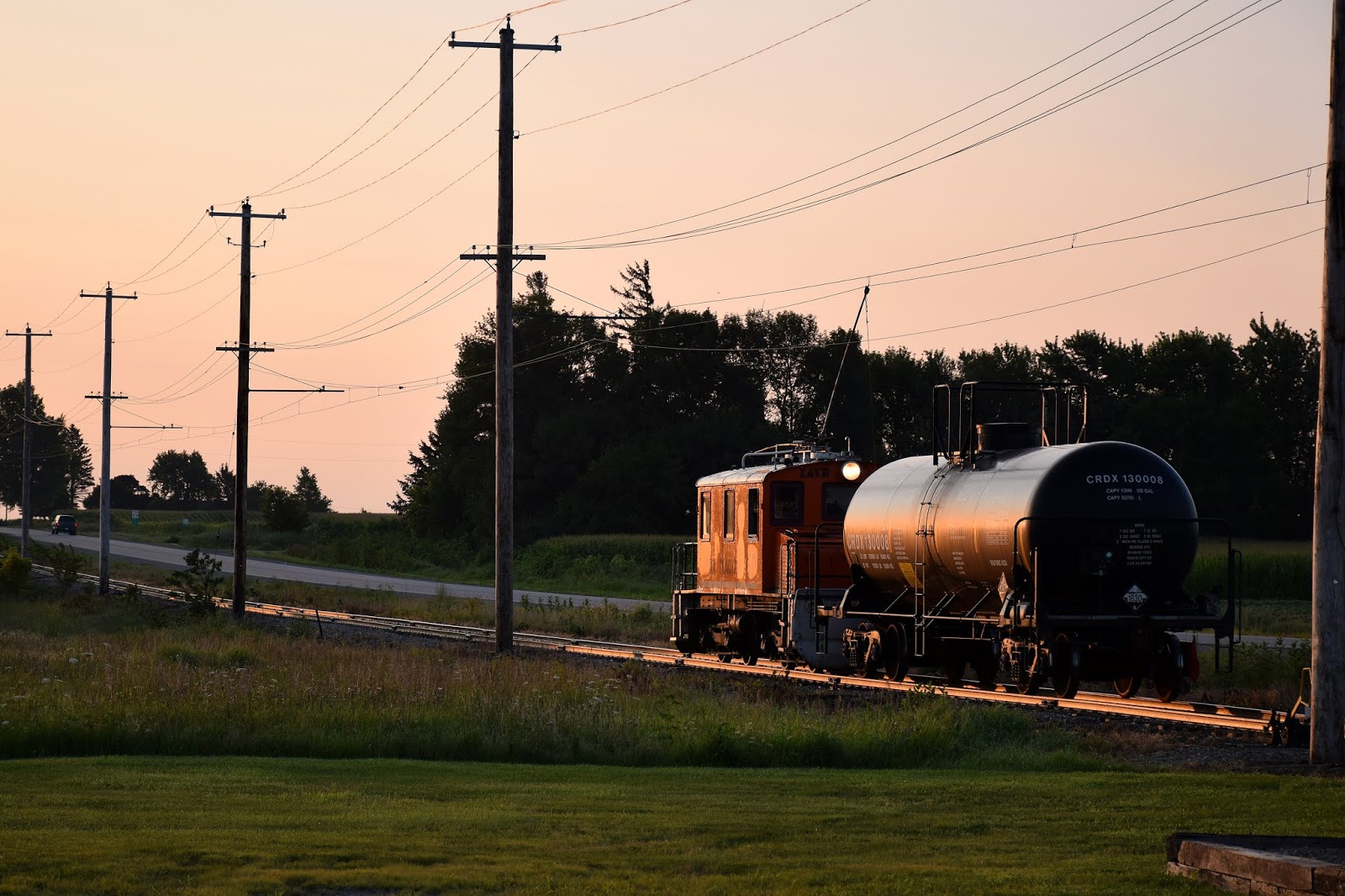
IATR motor 50 heads east from the small yard near its shops at a place called Emory, near the southwest corner of Mason City.
The few rural interurbans that survived did so only if there was sufficient freight traffic for them to at least break even financially, and their ranks dwindled quickly until there were only a handful left. One freight-hauling former interurban, the Chicago, South Shore & South Bend, still runs electric commuter trains, but its freight ops are all handled with diesel locomotives. For various reasons, the Mason City & Clear Lake Railroad stayed active, even through a couple name changes, until today as the Iowa Traction Ry., it is the sole survivor still moving freight using electric "motors."

Electric locomotives are "motors," not "engines". Diesels have engines, steam locomotives have engines, but electrics do not, so don't call them engines - they are motors. And the "engineer" is a "motorman," who will look at you funny if you call his motor anything else. The IATR's motors in particular motors are nearly all Baldwin-Westinghouse 50-ton "B" motors, very similar in function and appearance to motors that operated in the Palouse region earlier in the last century.

Electric locomotives are know for their longevity, as there is no "engine" to wear out over time. The youngest of the IATR's group is 90 (that's right, N-I-N-E-T-Y) years old this year!! These are, without question, the oldest locomotives still in regular service in the US. That's kind of a big deal.

I had very little up-to-date intel about the line and its operations, other than a knowledgeable friend telling me it was a Mon-Fri operation only, the crew gets an early start in the mornings, and depending on their workload, they could be done already by 9 a.m.  Oh yeah, she also told me sometimes they don't run on Fridays at all. Suspense!

The only way the trip would work for me was to squeeze it into a Friday-Saturday time window, meaning I would have to fly out of Pasco on a late Thursday afternoon and hope to arrive at Minneapolis in time to make the 2-hour drive south to Mason City, and be there just as the sun came up on Friday. My friend had suggested a couple other rail operations I could check out if the IATR wasn't running at all that Friday, but they would only be consolation prizes.

So on my chosen Thursday, I hit the ground at MSP right about 8 p.m. CDT and got my rental car with no problems. Driving south on I-35 as the sky darkened, I realized it had been a long time since I had been in the Midwest. A couple times during my visit, after concentrating on some aspect of the railroads, I would look up and have to remind myself where I was. At Albert Lea, Minnesota, I got off the Interstate and started investigating the railroad scene for real, despite the darkness.

I could've done a lot more homework prior to my trip, but I did bring a few maps and magazines with me hoping they would show where the tracks were, where they went, and which railroad used to own them. However, it turned out some of these were pretty out of date (no surprise) or incomplete, so I had to do some guessing. At Albert Lea, there was a closed up, brick interlocking tower that used to guard the crossing of the Rock Island "Spine Line" and a secondary Milwaukee Road route. I hoped I could use that tower as a photo prop sometime during my stay.

Taken the following morning, this UP local has just gotten a clear signal to roll south out of the siding at Manly, IA.
Driving south, I found that US Hwy 65 closely parallels the former Rock Island (now Union Pacific) line all the way to Mason City. This is a signaled line, but it appeared some signals were "approach lit" and dispatcher-controlled, while others were constantly lit and only displayed either green or amber unless one of the blocks were occupied. This led to at least one false alarm, because back home a green signal means the dispatcher has it lined that way for a quickly approaching train. Dead ends like that were OK, I had some time to follow them.

Approaching midnight, I arrived at Manly, Iowa. I know now this was a much more important junction point on the Rock Island than its current appearance would suggest. However, I understood that the Iowa Northern, a newer shortline, terminated here for interchange with UP. Off in the shadows, I could detect the presence of two IANR locomotives, so I logged this as another secondary location to check out sometime during daylight. Also while looking around here, I encountered my first train of the trip, a northbound UP manifest.
Finally, just at midnight I made my triumphal entry into Mason City, disappointed but not surprised at the lack of cheering crowds. Again, despite the darkness, I nosed around town to get a feel for where the tracks were and the easiest locations to view trains from. Along 19th Street, which parallels the IATR for its full length, I could see two of the motors, one on a spur track and another parked on the main and coupled to several cars. If I didn't see them running, I would at least see them.

With the short train continuing east in the early morning, and with little traffic on the highway, this photo could almost have been taken sixty or seventy years ago. If I cropped out that minivan, very few would be able to say this was taken in 2018.
Approaching the Emory shops at sunrise after snoozing in my rental car for a couple hours, I could see a lit headlamp indicating one of the motors was already at work. The crew of IATR number 50 shuffled a few cars in the yard, and then began rolling east with a single empty tank car. Interurbans, especially those in the Midwest, often closely paralleled early highways between towns, so even on this short run it was easy to imagine this was all taking place 40, 50, 60 or even 70 years earlier. Only the single mini-van on the highway spoiled the illusion.

The train made another stop about a mile east of the shops to retrieve two more tank cars from a lineside industry - possibly an ethanol plant. It appears that plant is served both by the IATR on the south and by Canadian Pacific (a former Milwaukee Road line) on the north. I also noted the plant had its own "trackmobile" to move cars around the facility and out to the IATR siding for pickup. Another mile or so of eastward travel brought the IATR train into Mason City proper.

The eastward Iowa Traction train passes a classic Iowa schoolhouse, now re-purposed as a community center. Get rid of that compact SUV on the highway, and this could have been taken in 1980. Remove the pontoon boat and the Ford Ranchero in the background and we could go back as far as 1940 perhaps.
Before the train could continue any further, its way was blocked by a string of  covered hoppers coupled to another one of IATR's motors, number 54. Easy peasy, the crew uncoupled from their three tank cars, rolled forward with the 50 to couple onto the soybean hoppers and uncouple them from the 54. They then hauled the hoppers back onto a siding, set the brakes, and pulled down the trolley pole on number 50. Then, hopping on the 54, they rolled west to grab the tank cars before proceeding east again to work the Union Pacific (former Rock Island) interchange.

I took this opportunity to make another run out to Manly, hoping to catch some action on the Iowa Northern. I didn't know how much longer the IATR crew would be working, but I didn't want to miss out on anything else interesting. As I approached Manly, I could see a locomotive headlight on the IANR tracks. Perfect timing, I thought as I parked and looked for a good location to photograph the departing train. However, the train then shoved backward into the yard and it became clear this was not a departing train, but only a switching crew at work. I still hoped for a good photo, but the engines were soon so deep in the yard that became impossible.

Dejected, I headed back to Mason City and found the IATR crew still at work. Now they were switching the CP interchange yard, which yielded some cool photos. When that work was done, the crew now headed west a short distance past the local Budweiser distributor, then "tied down" motor 54 and the motorman climbed back onto motor 51 for the final act of the day, working the AGP soybean plant across 19th Street from the IATR "mainline."

Pulling cars out of the Canadian Pacific (ex-Milwaukee Road) interchange yard.

Westbound past the local Anheuser-Busch distributor
As had been the case since sunup, the skies were perfectly blue and clear, and the angle of the AGP spur relative to the sun made for several near-perfect photos, including the shot seen at the beginning of this blog entry and the image below.

Working the AGP soybean plant
For the rest of the day, I checked out a few other photo opportunities. I spied a CP train on their ex-Milwaukee line and spent an hour or two shooting their bright red GP20C-ECO at several locations. This was my first time faced with this model, a nearly new locomotive built by EMD but with enough parts from retired locomotives for it to count as a rebuilt locomotive for tax purposes.

Unfortunately, I shot photos at enough different locations that the CP crew called me in to the city police as a "suspicious person." The officer I spoke with took me at my word that this was simply a recreational pursuit. He said the crew claimed they'd never seen someone so interested in their work. Either they're total newbies who've never seen a "foamer," or they know enough about rail enthusiasts to cause me a little grief as a prank.

Crossing Chelsea Creek in Mason City
After a few more passes around Mason City and its surrounding rail lines (six separate railroads once served Mason City, down to only three now), with a few other interesting photos "in the can," the sun began to sink and I looked for a place to eat. I found a restaurant in Clear Lake, right across the highway from the CP line, and hoped I'd get a crack at a train heading west, but no luck. Of course, after my meal as I headed to my AirBnB, I saw a westbound train on the CP line getting ready to depart Mason City, but it was too dark and I was too tired to do anything about it.

The next morning, I checked out a few artifacts I'd seen the day before, but where better photos would be obtained in the morning sun rather than the afternoon. These included the former Milwaukee Road depot, which may not be around much longer, and a very well-restored and well-presented Minneapolis & St. Louis RR locomotive on display in East Park (both seen below).


I also went back over to Clear Lake to pay my respects to Buddy Holly and his fellow early-rock-and -roll immortals at the site where their plane crashed on Feb 3rd, 1959, a.k.a. "The Day the Music Died." Rolling north back up US 65, I bagged a southbound UP train on the Spine Line at two locations, one on each side of the IA/MN border. Hoping for similar opportunities as I continued north toward the Twin Cities, I got "skunked" at the Albert Lea interlocking tower and at a really cool river crossing just south of Owatonna, MN, giving me additional reasons to come back to the area sometime.

Doing the Rock Island proud - Southbound UP freight on the Spine Line approaching Northwood, IA
In St. Paul, I tried to check out the Minnesota Commercial RR, and even saw a train at work. But, I had placed myself at an overhead vantage point, and when the train headed down the line, it took me too long to get back to my rental car and I missed what would've been some much better ground-level photos. I did spot a former Green Bay & Western RR Alco C-424 resting near the MCRR's enginehouse, which was kind of a big deal for me. Finally, with only an hour or so until I had to be at the airport, I checked out the rail lines along the Mississippi River between downtown St. Paul and the former CB&Q Dayton's Bluff yard and former Milwaukee Road's Pig's Eye yard, which yielded a couple more images of GP20C-ECOs.

So overall, it was a very good trip. I met my primary objective and saw a bunch of other cool things. Despite the IATR's electric locomotives having had exceptionally long careers already, I have a reasonable hope to see those motors still at work, even if it may be a very long time before I return to Mason City.

P.S: Mason City maintains a very close association with The Music Man, which was written by one of the city's favorite sons. The city promotes that connection heavily to boost what would probably be otherwise meager tourism spending. Although I can appreciate their civic pride, I also found it particularly annoying to find 76 Trombones blaring inside my head the whole time I was there! Curse you, Meredith Willson!!! At least I wasn't chasing trains in Gary, Indiana - that song is even worse.

Tuesday, July 31, 2018

Eddystone Excitement (subtitle: Bonkers for Baldwins)

DS 4-4-750 number 102 is a normally-aspirated, 6-cylinder, 750 hp locomotive built in 1951 for Youngstown Sheet & Tube's industrial railroad in that Ohio community. This day, it was assigned to SMS' contract switching railroad at Morrisville, PA
As I've mentioned on previous blog entries (here, here and here), one of my many side interests within the larger sphere of my railroad enthusiasm are the diesel locomotives once produced by the Baldwin Locomotive Works of Eddystone, Pennsylvania, an industrial suburb of Philadelphia. Not only are the remaining examples of Baldwin diesels extremely few, they are also extremely far between.

As of 2017, nearly all the Baldwin diesel locomotives produced between the early 1930's and 1956 have been scrapped. Of the few that remain intact, all but an extremely small handful are either found in museums or on display somewhere. And, of the tiny number of operable Baldwins left, even fewer are still used to generate actual revenue for an operating railroad. Because of my interest in these relics, I have visited several museums and/or display locations across the country to see, and possibly even touch them.

(Sorry, I hope the touching part doesn't sound weird - honestly having a chance to grip a handrail or run my hand along the sill for a moment helps cement in my mind that such fascinating objects actually exist and are not just a mental fabrication.)

The only two times I have seen Baldwins working for real was during a road trip to Arizona in 1990 and several times while driving past the Geneva Steel plant in Orem UT between 1988 and 1993. The one problem with the Geneva versions I saw in action is that they all had been re-engined with EMD diesels, so although their appearances did not differ much from their former all-Baldwin selves, they did not sound like a "real" Baldwin.

But over on the east coast, a small contract switching railroad has been serving several industrial parks for the last 15 or 20 years with a growing fleet of cast-off Baldwin products. I only knew about this because of articles in print and online (plus a lot of YouTube videos) showing actual Baldwins earning their own keep instead of relying on donations to shuffle around a museum. I looked up Pureland, New Jersey on Google Maps - that's the name of the industrial park where this SMS Rail Lines (www.smsrail.com) has its office and shops - and found it conveniently located just across the Delaware River from the Philadelphia airport.

And, incidentally, it's also right across the river from Eddystone, the land of those Baldwins' birth.

It took some time, but I finally saved up enough frequent flyer miles to obtain a standby ticket from Pasco, WA (my nearest airport) to Philadelphia with one stop on the way there and two stops on the way home. I also found a relatively inexpensive rental car deal and relied on AirBnB.com to help me find a cheap place to lay my head for a couple nights.

I made some unusual travel plans to ensure I would have the maximum amount of time "on the ground" in PA/NJ and still minimize my paid vacation time away from work. So I hopped on a flight on a Wednesday after work and arrived in Philadelphia right about midnight Eastern time. Getting into my rental car, I drove immediately to SEPTA's Eddystone commuter station, which also lies along Amtrak's famed high-speed Northeast Corridor. I figured a relatively well-lit public space would be a safe spot to take a nap and make up for missed sleep. I was partly right: it was safe enough, but my naps kept getting interrupted by Amtrak and SEPTA trains zipping past. Darn!

When the sun came up a few hours later, I started looking around a little. The first freight train I spotted was this one (below), running on an ex-Pennsylvania Railroad secondary line along the waterfront. I don't know for sure where it came from or where it went, but the spot where I photographed it may well have been right inside Baldwin's massive manufacturing complex when it still stood.


About 9 am, I headed across the Delaware and quickly found my way to the Pureland Industrial Park. Hearing the sound of a locomotive horn, I turned down one of the side streets expecting to see a real live Baldwin diesel hard at work. Not so fast! It was a middle-aged General Electric B23-7, still painted in it's former Santa Fe paint. This caused me some concern. Had I come all this way only to get "skunked" in my quest to experience working Baldwins?

The same road I turned onto was also the right one to access the SMS office, but I drove around the industrial park a little to get familiar with the area beforehand. I could see into the shop area from an access road slightly west of there, and could see several Baldwin locomotives parked there. Finally, I approached the office. I had sent an e-mail to the general manager several weeks prior, and he had welcomed me to drop in during my time in the area, so I went in the front door and asked for him.

Without going into much detail, Brian, the GM gave me a tour of the shop area, where two Baldwin diesels were undergoing work while the boiler, firebox and running gear of a steam locomotive sat in another corner and a nearly-complete project to restore a Reading RR caboose resided on the other side. Out on the apron of the three-track shop sat nearly a dozen Baldwin diesels in various stages of repair. Brian walked me around to each one and gave me a rundown on their current status. Several are operable, others need minor work to get to that point, and others are long-term projects.


Since the crew out working in the industrial park was using the bigger GE unit for the day, Brian did not expect I would see much Baldwin action that day. But, he did fire one up (A former Pennsylvania RR DS-4-4-1000 number 9069, restored by SMS to its as-delivered scheme and number) and let me ride along while he moved it over to the adjacent track. Not long after that, as I was examining more Baldwins, one of the crew came over and told me they needed to reposition a few cars spotted on one of the side tracks to make room for a HazMat training course they would be hosting the next day. If I wanted to ride along while they did that, I was welcome. So I got about another hour of cab time in the 9069 which was fantastic.

Earlier, I had signed a liability release form, so I was allowed to roam around and take a few more photos of the units out on the apron and the equipment in the shop. Brian had suggested that, since the HazMat program might put a crimp on any trains operating at Pureland the next day, that I should head up to their Morrisville operation on Friday morning. He would let the crew know to look for me and maybe give me another chance to ride along.

A real prize! One of only four operable Baldwin road-switchers (that I'm aware of, at least) and the only one of those four still working for a living instead of sitting in a museum. Throughout its career, SMS 554 worked for the Eagle Mountain ore hauling line in SoCal, ITT Rayonier's logging lines on WA's Olympic Peninsula, Trona Ry in the Mojave Desert, Johnston Terminal's switching ops in Oklahoma, and now the Pureland Industrial Park in NJ. Currently it is not in use, but will only require minimal maintenance to get it ready for whatever's next. And, once I know its running in regular service again, I plan to make another trip to the area.
By this time, it was about 1 p.m. and there was nothing more to see at Pureland for the day. I tried checking out the Conrail Shared Assets Operations (CSAO) line that interchanges with SMS by driving all the way down to Penns Grove NJ, where that line terminates. But, the CSAO local must have already turned and was well on their way back to Camden by that time.

This left me time in the day to investigate other rail ops in the area. While there were probably dozens of places I could have gone, I knew from a series of YouTube videos that Norfolk Southern's ex-Reading line between Reading (where else?) and Harrisburg, PA is a relatively busy mainline. Plus, there's a town on that line named Richland. Since I currently live in Richland, WA, this other Richland seemed a natural target. The map app on my phone showed Richland was only 60 miles away, so off I went.

But holy cow, that's the most time I think I ever spent driving 60 miles. Between slow traffic on the spider's web of freeways west of Philadelphia, plus even slower traffic on the side roads (most of which appear to be colonial-era cow trails), it was nearly 3 hours before I got there. When I finally arrived in Richland, it looked about like what I'd expected from the videos. I set up my tripod, ready to shoot video action just like the guy on YouTube, but the absence of trains after nearly an hour's wait gave me concern.

About this time, two young men approached me and asked if I was railfanning. No one who isn't already a railfan uses that term (the uninitiated usually use the shudder-inducing term "rail buff" - no thanks, I prefer to keep my clothes on while railfanning), so I figured these guys were worth hanging out with. We chatted for almost an hour. They were brothers and mentioned living a few miles outside town on a farm, but now working in town at an auto repair shop. I wondered if maybe they were Mennonite, based a little on their speech and dress; I was too far north for them to be Amish, and I'm not sure even the most worldly Amish carry a Canon DSLR under the front seat of their car.

An eastbound garbage train passed us while we spoke. I shot a video, but I was using my manual-focus 50mm lens (for better low-light performance, I think) but must have bumped it out of focus, so the video wasn't worth much when viewed later. After that, DeVon (the younger and more talkative of the two) and Curtis took off. I was watching the shadows getting longer and bemoaning the loss of the otherwise fantastic early-autumn light, when finally I heard a horn off to the east. The oncoming train turned out to be a local, like the one featured in an issue of Trains a few years ago, with a standard cab "geep" on each end.  This (cropped) photo shows how close I came to not getting a decent shot at all because of the long shadows:


Once I had committed this train's passage to my SD card, I headed back toward Philadelphia for check-in at the AirBnB I had arranged in the suburb of Rutledge. On my way, I also caught a glance of two East Penn Ry locomotives tied down at Reinholds, which is another railroad I'm familiar with from YouTube. The light was really low by now, so the shots I took with my f1.8 lens wide open still aren't very sharp. After meeting my host in Rutledge (nice lady - if you ever need a place to stay in the Philadelphia area, let me know and I can connect you with her), I went to sleep for a few hours.


Up the next morning before first light, I headed back down to the Eddystone SEPTA stop. One observation I'd made there the day before was two high-speed Amtrak trains, one in each direction,  passing that stop pretty close to 6:20 am. Since the NE Corridor is known for its (relatively) on-time performance, I figured being there a little after six would set me up to see them pass again. Sure enough, the two trains appeared within minutes of each other.

Exactly where he said it would be . . .
After shooting cell phone videos of them, I headed north toward Morrisville, and soon found the SMS Baldwin parked exactly where Brian said it would be. The crew appeared not long after, and upon seeing me, walked up and introduced themselves - Brian had told them to look out for me and help me get some good photos and video, plus to offer a cab ride, which they promptly did. I opted to stand back for photos and a bit of video while they switched out a nearby lumber distribution center. Once they were ready to head over to the interchange (again with CSAO), they stopped for me to board the diesel.

Rolling slowly toward the CSAO yard, we stopped again to retrieve an empty bulkhead flatcar from a steel service center. The crew let me off here so I could shoot more photos of their locomotive at work. After climbing back on the diesel, the crew left the two empty cars on a siding, from which a CSAO train would retrieve them later. We continued up to the yard, but held short of another track. Very soon, a local CSAO train with one NS "geep" on each end passed on the track ahead of us. My hosts explained it was heading off to work an industrial site where US Steel's Fairless Works once stood.

Pulling an empty bulkhead out of the steel yard
Hot on its heels, another train led by a nearly-new GE ES44-AC / EMD SD-70ACe pair crossed in front of us. This train, however, only had three loaded lumber flats behind the power, and it stopped nearly as soon as the last car cleared the switch - these were the cars meant for us. The CSAO ground guy, Big Jim they called him, threw the switch, we pulled ahead and then backed onto the lumber cars. Pulling ahead, Big Jim got the switch for us again, and we shoved them back toward our industrial park.

Passing the SMS "yard office", a former PRR caboose spotted on a spur, we pushed the lumber loads back to the distribution center. I hoped to hop off and shoot another photo or two of a green Baldwin switcher handling a train of finished lumber, but conductor Dan finished his job too quickly and soon we were back at the office, where they would now tie up for the day. Dismounting the venerable Baldwin, I thanked the crew again and headed out.

I had a few other things I wanted to see while in that area, mostly Revolutionary War sites and the campus of Princeton University. I also checked out the two-mile NJ Transit branch from Princeton to Princeton Jct., and in about 10 minutes at the junction, I also bagged a couple NJT and Amtrak trains rolling through at high speed.


Heading back south to Philadelphia, I walked around Independence Hall (but would like to have declared my independence from the parking ticket I got while there!), drove past the new LDS temple, and then up the Schuylkill River (because I missed the turn to see Philly's famous 30th St. Station). I ended the sunlit part of the day in a suburb called Manayunk, and walked a rail-trail where the PRR once crossed the river on a cool concrete bridge.

After another night at my AirBnB, I got up early to cram in a few more rail photos before I had to catch my flight home later that morning. Being a Saturday, I held little hope that SMS would be running at all across the river in Pureland, but I drove over there anyway. I was right about no SMS trains running, but I took another walk around the perimeter of their facility to snap a few photos of locomotives from their sunnier sides.

Then, as I headed back to the bridge with only a little time left before I had to check in my rental car, I took one more look down the CSAO branch through Bridgeport, NJ, I caught a glimpse of some movement. Sure enough, there was a CSAO freight heading south toward the Pureland interchange track. Even better, to get from Bridgeport to Pureland, the train had to wait for a small pivoting drawbridge to align with their tracks. I watched this operation, and then photographed as the train, led by two SD40-2s, one each from CSAO owners Norfolk Southern and CSX, rolled slowly across Raccoon Creek and through the marshlands. With that event capping a very exciting trip, I got on my plane and headed home.


Here's a sampling of more Baldwin diesels on the property at SMS:

This is a VO-1000, originally built in 1945 for the US Navy. It is owned by a New Jersey railroad historical society, but for now is kept at SMS' shops. It wears the colors of the Baltimore & Ohio Railroad.

SMS 300 is also a former Navy unit, built in late 1952. It is a supercharged, 1200 hp S-12 model, as are the majority of SMS' Baldwins.

This S-12 worked a long time in the iron fields of Northern Minnesota, but was originally built as Great Northern Ry. number 27 in early 1953.

This is a normally-aspirated 8-cylinder inline DeLaVergne engine, which may one day be used to keep another Baldwin in operation. This came from a Baldwin owned by a farmers' co-op in Northern Indiana that was scrapped several years ago. Also, this may be the only remaining example of this particular engine model.

SMS 308, also an S-12, was built in late 1953 for the Michigan Limestone Co. and served as their number 116.

The granddaddy of all SMS' Baldwins is the VO-660, originally Standard Steel number 12 (whose logo it still bears), was built in early 1940. The oval-shaped radiator grille was an early design element of Baldwin's diesels, until the more utilitarian looking rectangular grille took precedence. This is likely the oldest remaining example of Baldwin's diesels.

Saturday, May 13, 2017

"Ud og Se med DSB" = [Go] Out and See with DSB

One of my missionary friends, Ældste Karl Hugh, greets a passing freight train in proper Danish fashion.
Middelfart station, June 1986
As a much younger man, I spent 22 months working in Denmark as an LDS (Mormon) missionary.  And during that time I rode a lot of trains.  A lot.  Did this break my heart?  No, it did not.

The first train I rode in Denmark was “hyggetoget” leaving from the main Copenhagen train station (Københavns Hovedbanegård, or KBH for short) on the way to my first area in Kolding.  Each month for transferring missionaries around the country, the mission office relied mainly on two trains.  It worked like this: the intercity train that left KBH about 8 AM would haul all transferring missionaries moving west/north, and the train leaving the far end of the line at Fredrikshavn at the same time would haul all the transferring missionaries moving south/east.  Wherever you were in the mission, your transfer letter would instruct you to travel toward the mainline such that you ended up on the same train as the rest of the transferring missionaries.

A typical DSB route diagram. Frederikhavn is at the end of the rail lines at the upper (northern) end of the country, while Copenhagen is at the far east (right) edge of the map where all the lines converge.
"Hyggetoget" (the hygge train) was a nickname missionaries gave these two trains, because once you had boarded the train, it was easy to find and make friends among the other missionaries transferring that same time.  Hygge is a uniquely Danish word that implies comfortable companionship with good friends, and that's what we usually enjoyed for those few minutes traveling together.


This will always be my ideal passenger train - a Danish State Railways Intercity train with an MZ-class diesel leading a long string of B-class carriages. This eastbound IC train was photographed in my wife's hometown of Middelfart in May of 1993. The then-recent advent of mainline electrification to support the new IC-3 trainsets, meant this type of train did not have long to live.
So, on that first train there were several other missionaries leaving Copenhagen for new areas elsewhere in Denmark.  Cities we stopped where other missionaries may have hopped on or off the train included Roskilde and Slagelse on Sjælland, then Nyborg and Odense once we crossed Storebælt by ferry.  Middelfart could also have been one of those stops, except I’m pretty sure neither Ældste Lund nor Peterson transferred in or out of there that time.
For me, I got off the train at Fredericia and found my way to the train heading west toward Kolding and Esbjerg.  Søster Asplund, whom I’d met in the MTC, was transferring to Esbjerg, so we changed trains together.  With my Danish not being 100% yet (or even 10% for that matter), I had difficulty understanding the station announcements on the loudspeaker.  I almost got off at the first stop, Taulov, but Søs. Asplund helped me avoid that mistake.  The next stop was Kolding, where I stepped off and met my trainer, Ældste James Jensen.

Travel by train was a very frequent occurrence for all missionaries serving in Denmark, not just during the time I served. This photo was taken of my district while in Odense when Søster Bradley (front left) hopped on a train for a new assignment in København, August 1986. Søster Bradley's companion, Søster Dansie, is at my right. In the rear are (from L to R) my companion, Ældste Jeff Hill, then Ældste Chad Lambourne and Ældste James Healy. Within less than a year, I would have served as a companion to both of the other elders in this photo.

There was too much new stuff for me to process all at once, but after further experience with DSB, the Danish State Railways, I can now comment on the equipment used during this May, 1986 time frame.  The main Intercity trains, which ran the length of the KBH to Fredrikshavn mainline usually consisted of one or two 1st class cars (A vogne) and a long string of 2nd class cars (B vogne).  The only difference between the two classes were fewer, larger compartments in the 1st class cars and more, smaller compartments in the 2nd class cars.
These were the European style compartment cars, similar to those seen in the Harry Potter movies, with six-seat compartments along one side and an aisleway on the other side of the car.  In addition to the privacy afforded by the compartments, the best part of the cars was that the top half of the windows slid down! And if your compartment mates didn’t want it open, you could also stand out in the aisle and open one of those windows. "Læn Dem endelig ud!"
A typical DSB MR-tog, seen crossing Gudenaaen (Denmark's largest river) as it approaches Silkeborg in June 1987
MZ class locomotives pulled the IC trains almost exclusively.  These Swedish-built locomotives had EMD 16-cylinder, turbocharged 645 engines and rode on three-axle “C” trucks, so except for having two cabs pushed as far as possible to the opposite ends of the frame, these were equivalent to the SDP-40F locomotives once used by Amtrak.  Plus they were "dual-purpose", meaning MZs powered high-speed freight trains just as often as they did passenger trains.

An eastbound freight just west of Slagelse. It is led by an MX-class locomotive, with an MY-class and MH-class switcher in tandem behind the MX.
The smaller MX and MY classes with A-1-A trucks had EMD 567 engines, 12-cylinder versions for the 1425 hp MX class and 16-cylinder versions in the 1900 hp MY class, so they looked and sounded just like double ended American "F-units".  These saw use primarily on freight trains, although from photos in books I understand MYs may still have been used as passenger power on some of the more obscure routes while I was in Denmark.

Most of the DSB branchline passenger runs I rode were the MR-class self-propelled cars, very similar to the Budd RDC cars that ran some places in the US.  The MRs were two cars, each with a cab at one end, and semi-permanently coupled at the non-cab end to form an articulated dual-end car.  These had a more American-style seating plan with a central aisle and pairs of seats facing each other to form four-seat “pods”.  There was actually a two-seat compartment at the end of one of the cars, which were nice to ride in if not already occupied.  These were the trains serving much of the Esbjerg-Fredericia traffic, so Ældste Jensen and I rode them a lot to and from our Saturday post-P-day district meetings.  I also rode them frequently while serving in Silkeborg a few months later.
Another enjoyable aspect of rail travel in Denmark, up until about 15 years ago, was the need to cross Storebaelt (the Great Belt) between the islands of Sjælland and Fyn by ferry, instead of the bridge/tunnel now in place. Riders could leave their rail car and ascend to the upper decks of the ship, purchase refreshments, and enjoy the view and fresh air from the open decks. Sisters Dansie (left) and Asplund (right) join Elder Healy (center) and two I don't remember, November 1986.
Hers's a shot taken at Korsør of an MT-class switching locomotive shoving half of an intercity passenger train into the lower deck of the ferry Kronprins Frederick.  August, 1987
Nearly all my train travel while in Denmark consisted of trips on either local passenger trains to and from meetings, and occasionally on the IC trains either during transfers or to Zone Conferences. 
There was a “hobby” among the missionaries at that time of “collecting lines”, meaning one would trace on a map all the highway and rail routes they travelled during their mission.  I fell easily into this hobby because of my interests in geography, travel and railroads.  I collected some interesting routes by bus on a few occasions, but my favorites were those I covered by rail.  Some of these were part of our missionary work, and some were as tourists on P-days:
·         While in Kolding, we rode the train out to Esbjerg (July ’86) with other missionaries and members to attend a music fireside at the ward there.  Nici King (a recently returned missionary from Fredericia Ward, and my future wife) was also on this trip, and she regretted wearing the shoes she did because of the long walk from the station to the church.
·         Shortly before leaving Odense (Nov ’86), I arranged for a cab ride with a DSB engineer we’d met while tracting.  Unfortunately, I got transferred shortly beforehand, and Ældste Hill and Dozier had the most boring day of their lives on that trip.  They may have ridden an MY, but I’m not sure.


A Lollandsbanen Y-class arrives at Nykøbing F station, December 1987
·         While assigned to Nykøbing-Falster for a few weeks (Nov-Dec ’86), Ældste Talbot and I rode the private railway Lollandsbanen from Nykøbing out to Nakskov and back (equipment note:  all the private railways I rode used Y-class trains for passenger service, basically older versions of the MR trains DSB was using).


A typical DSB railroad depot for medium-size towns such as Silkeborg

·         While in Silkeborg (May of ’87 maybe), Ældste Linford and I were invited to spend a night at the President’s home in Greater København (can’t remember exactly where at that time - President and Sister Jacobs later lived in Holte).  We took the standard route to get there, but then received permission to return via the Kalundborg to Aarhus ferry, with some “rare mileage” (for missionaries, at least) by rail out to Kalundborg and between the Aarhus ferry dock and the station.


A section of my line map showing roads, railways and ferry routes I traveled while on my mission. The line from Herning, in the extreme upper left, angling southeast down to Vejle required special permission from the Mission President, since it deviated from the route I was directed to take when I transferred out of Silkeborg.
·         While transferring out of Silkeborg (July ’87), I called the office and received permission (after a lengthy and pointless discussion with Ældste Jakobsen) to deviate from my assigned routing (Silkeborg-Skanderborg) and travel via Herning to catch “hyggetoget” at Vejle, resulting in another rare mileage line on my map.
·         While in Slagelse (Aug ’87), Ældste Saunders and I rode to Høng on the Høng-Tølløse Jernbane at least once to visit some potential investigators.
·         Also while in Slagelse (Sep ’87), Ældste Lambourne and I rode down to teach a potential investigator living on the north edge of Falster.  On the return trip, we missed the next-to-last bus.  Although we then caught the last bus and successfully made our rail connection at Nørre Alslev, we were too late into Næstved to catch the last bus back to Slagelse.  Instead, we ended up hitchhiking halfway and walking the rest to arrive at our apartment about 5am the next morning.

Electric trains on Kystbanen - during my mid-1980's mission, this was the only electrified mainline in Denmark. Since then, nearly every mainline has been electrified. These locomotives were designated EA-class.
·         While in Næstved (Fall ’87) Ældste Lambourne and I took a P-day to visit a bunch of tourist sites in and around København on a P-day (equipment note:  the local trains on Sjælland almost exclusively used Bn class coaches in a push-pull configuration.  The end car facing toward København had a control cab, and the cars themselves were a center aisle style with two doors at the one-third and two-thirds points of the car’s length.  I did not like these cars very much. Power was either a Sjælland-only ME-class or an MZ).  He and I were no longer companions, but he was the DL for our district.  Neither my companion, Ældste Morrow, nor Ældste Lambourne's comp wanted to travel that day, so we paired them up at our apartment, and then Lambourne and I headed out. This arrangement probably would not be allowed today.  I don’t remember our exact routing, but I’m pretty sure it included the electrified Kystbane (Coast line) up to Helsinør, and the private railways to Hillerød and Fredriksværk before returning home.
·         Also at some point while in Næstved, I believe Ældste Roe and I returned from a meeting in København via Køge.  This would also have been rare mileage for missionaries back then.
·         I also seem to remember a trip to Gedser, at the far southern tip of Falster, and then back to Nykøbing, again just for the sake of a “line”.
·         In my last area, Birkerød (Jan-Mar ’88), Ældste Kolditz and I probably rode the Hillerød to Helsinør route at least once more.  And, we also rode a lot of S-tog commuter trains in the Greater København area.

Denmark's own IC-3 trains.  Great for riding, but kinda awful to look at.
I have returned to Denmark five times since my mission and ridden trains for some portion of all these trips.  My biggest disappointment has been the onslaught of diesel and electric IC-3 trains that now carry passengers on nearly all DSB routes.  I’m pretty sure things hadn’t changed too much rail-wise when I visited Nici for Christmas of 1989, but on subsequent trips it has all been IC-3s and newer versions of the old MR trains. The IC-3s are designed and built in Denmark by Scandia of Randers.  Yes, they are sleek and functional, but the blunt ends - intended for ease of coupling multiple sets in series - represents the absolute lowest point ever for Danish design (my opinion). Great for riding, but kinda awful to look at.

“Sølvpilen” captured at speed just west of Slagelse in the summer of 1987
The high point of my ’89 trip, besides spending time with my intended, was returning to København aboard DSB’s “Sølvpilen”, the silver-bodied “lightning train” that was the ultimate in speed and comfort in its day.  The ride wasn’t that much more exciting than a standard IC train, but at least I can say I rode it before it was gone.
A newer self-powered passenger train passes the tiny community of Napstjært, where some of my 19th Century Danish ancestors were born. July, 2010.
On that trip, we also rode the train up to Fredrikshavn to visit Nici’s cousins Marianne and Kaj.  This was my first time traveling north of Aarhus.  Their home sits only a few meters away from one of the platforms for another private railway, Skagensbanen.  We visited them again in May of 1993, and that time I arranged to ride the Y-train up to Skagen and have Nici and Marianne meet me up there.  This ride also took me through my “ancestral home” (at least on Grandpa Brady’s maternal side) of Napstjært, so I videotaped part of the ride for posterity.
During this visit, I also made a side trip to Silkeborg, with a stopover in Aarhus to see Shad and Ulla Roe, my former companion and his wife.  He had also married a Danish girl but they chose to live in Denmark rather than the US - I can't always say I blame them.  They lived south of Aarhus and I rode another private railway Y train with him down to their home, and then by myself back up to Aarhus after our visit.
I did not have much time for recreational train riding during trips 3 and 4.  Number 3 was to see the Copenhagen LDS Temple and to visit my mother-in-law Ellen King one last time, and number 4 came a year later to arrange Ellen’s funeral with Nici.

The main railway station at Malmö, Sweden. July 2010
However, when our whole family went over in July 2010, I managed a little better.  Most of our travel was driving a rented Citröen, but I did catch an IC-3 to Slagelse one evening to meet up with another former missionary friend.  At the time, he worked for Railion - the current contract operator of freight trains on DSB rails.  I rode with him over to Malmö, Sweden for my long-awaited cab ride.  This time it was aboard a German DB electric locomotive, at the head end of a high-speed freight on the routing the new Øresund and Storebælt bridges has opened up.  Another engineer took over for my friend at Nyborg, but my friend continued with me as far as Odense, where my rental car was parked.  Between the late hour, welded rail, an electric locomotive, and green signals nearly the whole way, it was a pretty anticlimactic trip and I’m sure I dozed at some point.  Still, I was grateful for the experience!

Late-night, speed-blurred view of Roskilde Station from my 2010 cab ride.
Here are a few more images of favorite Danish locomotives:

With lines very similar to the classic American "F-unit" locomotives, and with diesel engines identical to them, DSBs MY- class are easily my favorites. I shot this particular one at Nykøbing-Falster, and by chance MY1154 was one of the last two to operate in regular service on DSB twenty years later.
By luck, I also managed to photograph this rare specimen at Nykøbing-F. Manufactured by Frichs, a Danish builder at Aarhus, the eight examples of this model, only owned by Danish privatebaner - private railways, did not have a class designation. Instead, they came to be known as "Marzipanbrød" because their curved roof and ends bore resemblance to chocolate-covered marzipan candy bars.

Most Danish trains today run off the electrified catenary wires. This one is an EG-class hauling empty container cars westbound near Odense in July 2010


Plus, here are a few segments of video I've shot on post-mission visits to Denmark:

From May 1993:


From February, 2007:


And from July 2010: